

When I found out my great-great-great-great-grandfather was Paolo Sarpi, I wondered if I could be descended from the famed Italian historian, jurist, and papacy-rejecter. As it turns out, I was not. Instead, I discovered that my Paolo Sarpi was born 200 years later, in 1818, and when he was just a few hours old he was left on a foundling wheel in Morcone, a town in the Molise region of Italy.
Before foundling wheels were brought into practice, illegitimate or otherwise unwanted babies were left at the church gates under cover of night. Having a child outside of marriage was considered particularly shameful in Italy, despite the frequency with which it occurred, and the shame extended not only to the woman who bore the child but her entire family. Giving up a child because of poverty was also stigmatised. But infants exposed to the elements for hours or even overnight often died, particularly in the winter. The wheel, or “ruota dei proietti” — literally the wheel of projectiles/throwaways — was created to allow a woman to give up her child and maintain her anonymity, making it possible for her to marry and attain some level of respectability in the future.
The foundling wheel was attached to a church or convent and turned horizontally, like a lazy susan. A woman could deposit her baby in secrecy, turn the wheel, and seconds later the baby would be inside the protection of the church. There was usually a bell the mother could ring before fleeing into the night, to alert the nuns inside that another baby had arrived.

Many mothers hoped to eventually come back and retrieve their children, and it was common to leave a token of some kind with the baby so that the mother could identify her child in the future. The “segnale di riconoscimento”, or “signal of recognition”, was often a small metal token, such as a coin, crucifix, or religious medallion, split in two pieces; the mother kept one and the other was left with her baby. The London Foundling Hospital similarly took in “exposed and deserted infants” and made a note of any writing or objects that were left with a child.
The most important fact about the tokens is that they were left as identifiers — they were not gifts for the children, keepsakes or love tokens, as has often been stated. They were official ‘documents’ — easily recognisable items that could be used to prove the identity of an infant if the parent or parents found themselves in circumstances to take it back. Literate parents could leave notes or letters as identifiers, keeping copies for themselves, but those that could not write had to use something they could accurately describe when they came to reclaim their child.1
In Italy, churches kept a file of the tokens, allowing the child to be identified if the mother returned. Thus the former Ospedale degli Innocenti (Hospital of Innocents) in Florence, which had a foundling wheel next to its entrance, is now a museum that displays some of the more than 40,000 tokens received between the first baby left on its foundling wheel in 1445 until the wheel was taken out of service in 1875. A commemorative plaque at the site reads, “This was for four centuries, until 1875, the Wheel of the Innocents, a secret refuge of miseries and sins which were perpetually helped by that charity that does not close doors”.2

The miseries of the mothers leaving their children were not just due to guilt about “sin,” however. While many mothers abandoned “illegitimate” newborns due to the social stigma of having a baby out of wedlock, others were married women, some with many children already, who could not afford another mouth to feed. Having been forced by poverty to abandon their children, women hoped that once their financial situations improved, they would be able to retrieve them. It was not uncommon for mothers to do so, although sometimes they arrived too late, as the mortality rate for abandoned infants was painfully high.
My great-great-great-great-grandfather didn’t have any tokens on him when he was left on the foundling wheel in Morcone, but his birth record noted that the infant was wrapped in a linen blanket and was wearing a red silk bonnet.
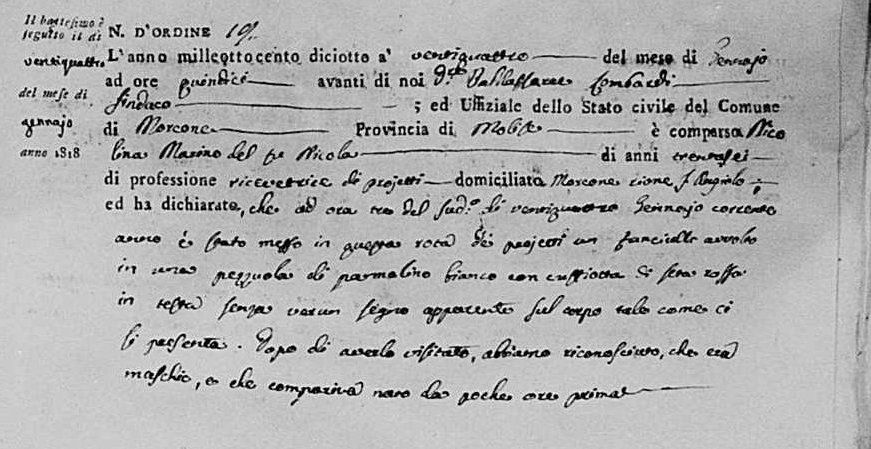
The birth record reads:
On January 24th, 1818, before the civil status officer of Morcone appeared Nicolina Masino, receiver of foundlings, who declared that during the night someone had deposited a child on the wheel, wrapped in a white linen blanket and with a red silk bonnet on their head, and without any distinctive sign whatsoever. The officer visited the child, ascertained that he was a male and that he was born a few hours before, and bestowed to him the name of Paolo and the surname of Sarpi.3
Linen and silk were expensive fabrics that the average contadina would likely not have access to, so the babe may have come from a wealthier household, suggesting he was born out of wedlock, rather than given up due to poverty. The silk bonnet may be why the registrar gave the baby the name of a famous statesman instead of one of the more standard names given to abandoned infants. One of those names, Esposito (exposed, as in exposed to the elements), is now one of the most common surnames in Italy. Other surnames were given, Games of Thrones style, based on where they were born. Abandoned children in Rome were often given the surname “Proietti”, meaning, approximately, “throwaway.” A foundling home in Sienna gave the children there the surname “Della Scala” or “from the stairs”. “Incogniti” (unknown), “Innocenti” (innocent), and “Trovato” (found) were other names given to abandoned babies.

Roman law gave parents the right to abandon their children, and John Boswell estimates that between twenty and forty percent of urban Roman children were abandoned in the first three centuries of the Christian era.5
While the rate of “illegitimate” births in Italy did not stand out among other European countries, the rate of unwed mothers keeping their children was particularly low. David Kertzer explains that it was in Italy where the European system of child abandonment began in the 13th century, in which parents could anonymously give up their babies to foundling homes, and this system eventually spread through most of Catholic Europe.6 About the Kingdom of Naples, which encompassed all of the Italian south and Sicily before Italian unification in 1860, Carlo Bressan wrote:
The number of exposed children in the kingdom of Naples corresponds exactly to that of illegitimate children, since just as it is rare for a young woman who has become a mother to keep her own child with her, it is equally rare for legitimate children to be brought to the hospice.7
Milan stood out for its rate of infant abandonment. Between 1659 to 1900, 43,406 children were left at the Milan foundling home, the majority of them between 1810 and 1869.8
The crisis of children being abandoned to foundling homes spread to families. By the 18th and 19th centuries the majority of children in Milan and Florence who were being abandoned had been born in wedlock.9 Rising poverty and the rapid rate of industrialisation, particularly in Milan, were likely to blame. In rural Campania, where my great-great-great-great-grandfather was abandoned, some children may have been sent to the Annunziata foundling home in Naples. But post-Napoleonic law in the Kingdom of Naples required communities, few of whom were large enough to have their own foundling homes, to “accept any and all abandoned children and forbade them to inquire into their origins”.10 This usually meant being sent to a wet nurse in the same town the child was abandoned in, the same town where, often, the child’s mother lived.
Despite being given such a grand name, my Paolo Sarpi did not become a distinguished citizen. I have not found any records that indicate where and how he was fostered, but foundling boys were often thrust out into the world at very young ages to begin working to support themselves. 11

At some point he moved to Fragneto Monforte, about ten miles from Morcone, where he worked as a tailor. He married and eventually had ten children with his wife, Maria Nicolina Guida. Every year the church took a census of every citizen of the town, and every year they noted that Paolo was an “esposito”.
The “ruota dei proietti” gradually fell out of favour. The foundling wheel had granted anonymity to the mother who abandoned her child, and also freed the child’s father from any financial responsibility. When the church and society believed that this gave unwed mothers the opportunity to unshackle themselves from permanent evidence of their sinfulness, and illegitimate babies the chance to have a better upbringing, the wheel was begrudgingly supported. But when more and more married couples began depositing their babies on the wheel, some foundling homes, such as Milan, closed their wheels and demanded mothers submit to a personal interview before their child would be admitted.
Italy outlawed the foundling wheel in 1923. But today in cities across the country more modern versions have appeared. Some hospitals now have a hatch that allows mothers to deposit their babies into a heated crib outfitted with motion sensors. In Bergamo, a cloistered convent has a heated cradle with an alarm that sounds to alert the nuns when a baby is left. The old wooden foundling wheel may be long gone, but the reasons it was needed in the first place have not disappeared.
Janette Bright and Gillian Clark, An introduction to the tokens at the Foundling Museum, London, 2023, p. 3. ↩
Andrea Guida, ‘La storia della “ruota” degli Innocenti: cos’era e dove si trova a Firenze’ Firenze Today, 6 Feb 2023. ↩
Paolo Sarpi, Morcone, Molise [now Benevento, Campania], Italy, birth, 24 Jan. 1818 (Archivio di Stato di Benevento, 1113/10 ↩
Paulo Sarpi, Morcone, Molise [now Benevento, Campania], Italy, birth, 24 Jan. 1818 (Archivio di Stato di Benevento, 1113/10 ↩
John Boswell, The kindness of strangers : the abandonment of children in Western Europe from late antiquity to the Renaissance (New York, 1988) p. 135. ↩
David Kertzer, Sacrificed for honor: Italian infant abandonment and the politics of reproductive control (Boston, 1993) p. 8. ↩
Carlo Bressan, I trovatelli e la chiusura delle ruote (Padova, 1870), p. 57. ↩
Kertzer, Sacrificed for honor, p. 77.) The rate of abandonment was staggering. In Florence more than 40 percent of children were abandoned in some years in the early 1800s. In Milan the rate of children being abandoned approached one in four by 1800, and climbed even higher in the years after. ((Boswell, Kindness of strangers, p. 16. ↩
Kertzer, Sacrificed for honor, p. 71. ↩
Kertzer, Sacrificed for honor, p. 89. ↩
When the Milan Foundling Hospital was founded in 737 CE, Datheus, the archipresbyter, declared, “When weaned, they stay in the house until 7 years old, are sufficiently taught a trade, and receive from the hospital food, clothes, and shoes. When they have completed 7 years, they are free, absolved from any bond of slavery, and may go wherever they will.” Michael Obladen, ‘Exposed and Abandoned. Origins of the Foundling Hospital’ in Neonatology, 1, no. 120 (2023), p 135. ↩