
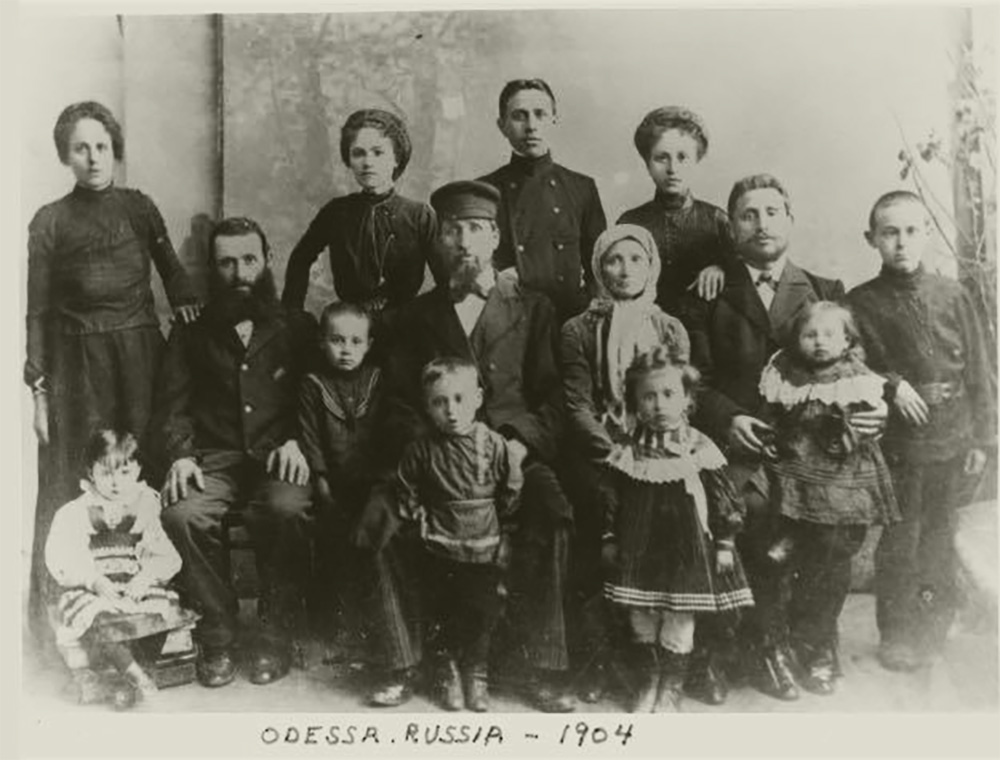

Maybe my ancestors heard the Yiddish expression “to live like God in Odesa!” and believed Odesa was the land of opportunity. Whatever the reason, members of three branches of my family emigrated there from within the Russian Empire. Mythical in the Jewish imagination, Odesa was a polyglot, free port city founded on the Black Sea in 1794 by Catherine the Great. It had a reputation as a free-wheeling frontier town, with lax laws, warm weather, and relative freedom for the city’s Jewish population. To encourage fast population growth, Catherine allowed anyone to settle there, even Jews.
Odesa quickly became a booming cosmopolis where Jews had greater religious freedom than anywhere else in the Russian Empire. All ethnicities and religions were allowed to finance and build their own places of worship, schools, clinics, and libraries, operated in their own languages. An 1855 travel guide declared, ‘There is, perhaps, no town in the world in which so many different tongues may be heard as in the streets and coffeehouses of Odessa, the motley population consisting of Russians, Tartars, Greeks, Jews, Poles, Italians, Germans, French, etcetera.’
Tax and other financial incentives also made the city an attractive destination for entrepreneurs and traders. The city was as much European as Slavic, with stunning architecture and wide, tree-lined promenades. In the 1880s the train lines of many of the cities in the Russian Empire were linked, making travel easier than ever. Jews from towns and shtetls across the Russian Empire flocked to Odesa, and it soon had one of the largest Jewish communities in the world. This had an undeniable impact on the city and its unique culture; some argued that Jews were what made the city Odesa.

Two of the Jewish internal migrants who moved there were my great-grandparents. My great-grandmother, Sarah Schechewitz, was from Volochysk, in what is now Ukraine. In the 1880s at least two dozen members of her extended family moved to Odesa, part of a wave of Jewish migration that began when Jews were scapegoated for the 1881 assassination of Tsar Alexander II. His death led to an outbreak of violent pogroms in cities around the Russian Empire, including Volochysk. The reactionary ‘May Laws’ designed to oppress the Jewish population were passed soon after.
Some two-and-a-half million Jews left the Russian Empire between 1880 and 1920. Most headed to the United States, but many stopped in Odesa as the first step in their migratory journey. My great-grandfather, Emanuel Goldberg, a shoemaker from Przedbórz, Poland, was one of them.
There is considerable disagreement about the causes for this great wave of Jewish migration. The traditional belief was that it was crisis-driven, specifically by the violence in the wake of Alexander II’s assassination. Jonathan Frankel argued that 1881-1882 was a turning point for Jews, who became disillusioned with the dream of assimilation into Russian culture, which no longer seemed possible. More recent scholars, such as Benjamin Nathan, argue that Jewish migration was already well underway by this time. However, there were pogroms in Odesa, too, suggesting that fleeing violence was not the sole motivation for people like my great-grandparents.
One way of looking at Jewish migration during this period is to use Ravenstein’s framework as described in ‘The laws of migration’, which used a contemporaneous European model. However, Jewish migration did not fit neatly into this framework. Using what records were available, Shaul Stampfer analysed Jewish internal migration and found several key differences. While Ravenstein posited that short-distance migration was more common, Jewish migrants tended to go long distances. In addition, Jewish internal migration more often included entire families than in the non-Jewish population, although a male ‘pioneer’ often left first to earn enough for the rest of the family to follow. There was also no evidence of a counter-stream of migration back to the towns and shtetls the Jews were abandoning. Nor were urban Jews were more likely to migrate. In other ways, though, Jewish internal migration fit Ravenstein’s mould. Most went to urban centres with strong economic growth, such as Warsaw and Odesa. Finally, Jewish migration increased due to better access to transportation.

The culture and economy of Odesa was shaped by the Jewish population. Some of the early Galician Jewish residents of Odesa became bankers and wealthy grain merchants, controlling the grain trade that provided England with much of its bread. Historian Jarrod Tanny writes:
By 1875 Jews controlled sixty percent of Odessa’s commercial firms. In 1881 Jews comprised sixty-six percent of the city’s registered merchants and traders, eight-six percent of brokers, forty percent of doctors, and sixty-seven percent of pharmacists. In 1796 a Jewish man was one of ten candidates elected to the municipal civil court. Eleven Jews held posts in the city government in 1851. Such statistics indicate that Odessa, in many respects, was becoming a Jewish city.
The lingua franca of Odesa was a mishmash of Russian, Ukrainian, and Yiddish. By the time the 1897 census was taken, there were more than fifty languages being spoken there, but a quarter of Odesa’s residents spoke Yiddish as their native tongue, and more than a third of the city identified as Jewish. Jews were allowed extensive civic freedoms, while elsewhere in the Russian Empire Jewish city officials were unheard of. Freedom and success came at a price, however: violent antisemitic pogroms were a regular occurrence.
Odesa was the centre of Hebrew and Yiddish publishing and a Jewish intelligentsia. It was a famous literary city, where Jewish authors wrote in multiple languages for both Jewish and Russian audiences. They included journalist and novelist Vladimir Jabotinsky, and Sholem Aleichem, who wrote the Tevye stories that inspired Fiddler on the Roof. One of the best known is Isaac Babel, who affectionately wrote about the moxie of the city’s Jewish gangsters and the wit of the tricksters in the Jewish underclass. This uniquely Odesian humour was a hallmark of Babel’s writing, and of the city itself. So too was the criminality. Another Yiddish expression, ‘the fires of hell burn for seven miles around Odesa’, alluded to the criminal reputation the city had developed, and to its relative liberalism, which encouraged secularism and Jewish assimilation. Babel’s depiction of Jews as thugs and criminals pushed back against the stereotype of Jewish men as weak and cowardly and fit the reputation of the city as fostering a new type of muscular Judaism, with a population who may have abandoned their shtetl garb and piousness but were willing to defend themselves.

While the city’s wealthy Jewish bankers and traders lived in the centre of the city, much of the city’s Jewish population were living in relative poverty in Odesa’s Moldavanka neighbourhood. My great-grandparents were of the latter class. Married in Odesa in 1893, they were recorded on the 1897 census as illiterate and living on Bolgarskaya, in the heart of Moldavanka. The failed 1905 revolution marked a turning point for both my family and the city’s Jews. In October of that year hundreds of pogroms took place across the Russian Empire, with the most terrible taking place in Odesa. For a period of several days, Christians, with the support of police and local government, rioted and looted. They overwhelmed the newly formed Jewish self-defense league and went house to house, robbing, raping, and murdering the terrified Jewish occupants. British newspapers’ Odesa correspondents described horrifying atrocities, with one calling the scene in Moldavanka a ‘massacre’ and another terming it ‘dreadful butchery’ leaving streets littered with corpses.
This wave of pogroms proved to be the impetus for many of Odesa’s Jewish residents to leave, including my family. It’s clear they had already been considering migrating because my great- grandmother and her sister both had birth certificates issued for their children in the weeks leading up to the 1905 revolution, but the violence in their neighbourhood must have been the final push.
While every Jewish family from the Russian Empire in this period has their own story, most, like mine, fit Stampfer’s analysis. My family migrated long distances to Odesa, an urban centre. Their migration was likely prompted by greater transportation options — Volochysk got a railway station in the 1870s — and economic opportunities. Although Stampfer could not determine whether or not Jewish migration proceeded step by step, my family’s certainly did. Their two-decade sojourn in Odesa was the first stop in the eventual chain migration of the entire extended family to Glasgow and then New York, where they, not unsurprisingly, settled in an immigrant Jewish enclave in Brooklyn. Like most Jewish migrants my family experienced both push and pull factors for each step of their journey. Antisemitic violence drove them from their shtetls and towns, but they were also lured by the new freedoms and economic opportunities that beckoned.
Bibliography
Primary sources
Odesa State Archives, Odesa, Ukraine
Goldberg, Emanuel (head), Odesa, f. 2, о. 8, d. 185, Odesa State Archives, ‘1897 all-Russia census’ (https://www.familysearch.org/ark:/61903/1:1:68PX-YJ87) (13 Apr. 2024).
Marriage record of Emanuel Goldberg and Sarah Parnys [Schechowitz], 9 Mar. 1893 (Odesa State Archives, Rabbinate records, f. 39, o. 5, d. 68).
Birth record of Gersh Goldberg, 25 Sep. 1897 (Odesa State Archives, Rabbinate records, f. 39, o. 5, d. 83, no. 1641).
Birth record of Rukhel Malya Goldberg, 2 Aug. 1900 (Odesa State Archives, Rabbinate records, f. 39, o. 5, d. 95, no. 1398).
Birth record of Liba Vaynbluym, 8 Jun. 1901 (Odesa State Archives, Rabbinate records, f. 39, o. 5, d. 99, no. 943).
Zhytomyr State Archives, Zhytomyr, Ukraine
Volochysk revision list addition entry for Moishe Srulovich Shakhovich, 25 Apr. 1851 (Zhytomyr Oblast State Archives, Zhytomyr Jewish community records, f. 118, o. 14, d. 48, no. 3).
Volochysk revision list entry for Srul Mikhelovich Shakhovich, 1850 (Zhytomyr Oblast State Archives, poll-tax of Jewish communities of Volhynia province, f. 118, o. 1, d. 277, no. 76).
Newspapers
Daily Telegraph, 23 May 1881.
Daily Telegraph, 6 Nov. 1905.
Guardian, 8 Nov. 1905.
Jewish Voice, 25 Nov. 1909.
New York Times, 29 Nov. 1905.
Times (London), 24 May 1871.
Western Daily Press, 10 Jul. 1871.
Western Morning News, 6 Nov. 1905.
Printed works
E.A. Goldenweiser, ‘Economic conditions of the Jews in Russia’ in Publications of the American Statistical Association, ix, no. 70 (1905), pp 238-248.
Sears, Robert, An illustrated description of the Russian Empire (New York, 1855).
Secondary sources
Dubnow, Simon, History of the Jews in Russia and Poland: from the accession of Nicholas II until the present day, iii (Skokie, 2001).
Frankel, Jonathan, ‘The crisis of 1881-1882 as a turning point in modern Jewish history’ in David Berger (ed.) The legacy of Jewish migration: 1881 and its impact (New York, 1982), pp 9-22.
Grosfeld, Irena, Sakalli, Seyhun Orcan, and Zhuravskaya, Ekaterina, ‘Middleman minorities and ethnic violence: anti-Jewish pogroms in the Russian Empire’ in Review of Economic Studies, lxxxvii, no. 1 (2020), pp 289–342.
Herlihy, Patricia, Odessa: A history, 1794-1914 (Cambridge, USA, 1986).
Herlihy, Patricia, Odessa recollected: the port and the people (Boston, 2018).
Horowitz, Brian, ‘“Both crisis and continuity”: a reinterpretation of late-tsarist Russian Jewry’ in ‘Russian idea, Jewish presence’: essays on Russian-Jewish intellectual life (Brighton, MA, 2013) pp 105-122.
Jabotinsky, Vladimir, Story of my life (Detroit, 2016).
King, Charles, Odessa: genius and death in a city of dreams (New York, 2011)
Lederhendler, Eli. ‘Classless: on the social status of Jews in Russia and eastern Europe in the late nineteenth century’ in Comparative Studies in Society and History, l, no. 2 (2008), pp 509–34.
Manning, Patrick and Trimmer, Tiffany, Migration in world history (3rd ed., London, 2020).
Nathans, Benjamin, Beyond the Pale: The Jewish encounter with late imperial Russia (Los Angeles, 2002).
Polonsky, Antony, The Jews in Poland and Russia: 1881 to 1914, ii (Liverpool, 2019).
Ravenstein, Ernst Georg, ‘The laws of migration’ in Journal of the Royal Statistical Society, xlviii, no. 2 (1885), pp 167-235.
Ravenstein, Ernst Georg, ‘The laws of migration’ in Journal of the Royal Statistical Society, lii, no. 2 (1889), pp 241-305.
Smith, James Stewart, The last time: memoirs of a colonial officer in Nigeria and the southern Cameroons (2nd ed., n.p., 2019).
Stampfer, Shaul, ‘Patterns of internal Jewish migration in the Russian Empire’ in Yaacov Ro’i (ed.) Jews and Jewish life in Russia and the Soviet Union (New York, 1995), pp 37-56.
Tanny, Jarrod, City of rogues and schnorrers: Russia’s Jews and the myth of old Odessa (Indianapolis, 2011).
Weinburg, Robert, ‘The pogrom of 1905 in Odessa: a case study’, in John Klier, (ed.) Pogroms: anti-Jewish violence in modern Russian history (Cambridge, 1992), pp 248-290.
Weinberg, Robert, ‘Workers, pogroms, and the 1905 revolution in Odessa’ in Russian Review, xlvi, no. 1 (1987), pp 53-75.
Zelitsky, Paulina. Odessaphile: Jews in Odessa: a story of cultural cross-pollination (Ontario, 2014).
Zipperstein, Steven, The Jews of Odessa: a cultural history, 1794-1881 (Stanford, 1985).
Webpages
Bridgens, Ruth, ‘The pogrom at Moldavanka’, Odessa Secrets (https://odessasecrets.wordpress.com/2015/09/15/the-pogrom-at-moldavanka) (13 Apr. 2024).
History.com, ‘Pogroms’ (https://www.history.com/topics/european-history/pogroms) (13 Apr. 2024).
Literary Hub, ‘On the richness of Isaac Babel’s Odessa’ (https://lithub.com/on-the-richness-of-isaac-babels-odessa) (13 Apr. 2024).
Rosenthal, Herman. ‘Alexander III, Alexandrovich, Emperor of Russia: The May Laws’ (https://www.jewishencyclopedia.com/articles/1132-alexander-iii-alexandrovich-emperor-of-russia#anchor4) (13 Apr. 2024).
Vinokir, Val,‘Babel’s extended ode to Odessa’, Translation of Isaac Babel, ‘Odessa’, Odessa Review, (https://odessareview.com/babels-extended-ode-to-odessa) (13 Apr. 2024).
YIVO encyclopedia of Jews in Eastern Europe, ‘Pogroms’ (https://yivoencyclopedia.org/article.aspx/Pogroms) (13 Apr. 2024).
YIVO encyclopedia of Jews in Eastern Europe, ‘Sholem Aleichem’ (https://yivoencyclopedia.org/article.aspx/Sholem_Aleichem) (13 Apr. 2024).