
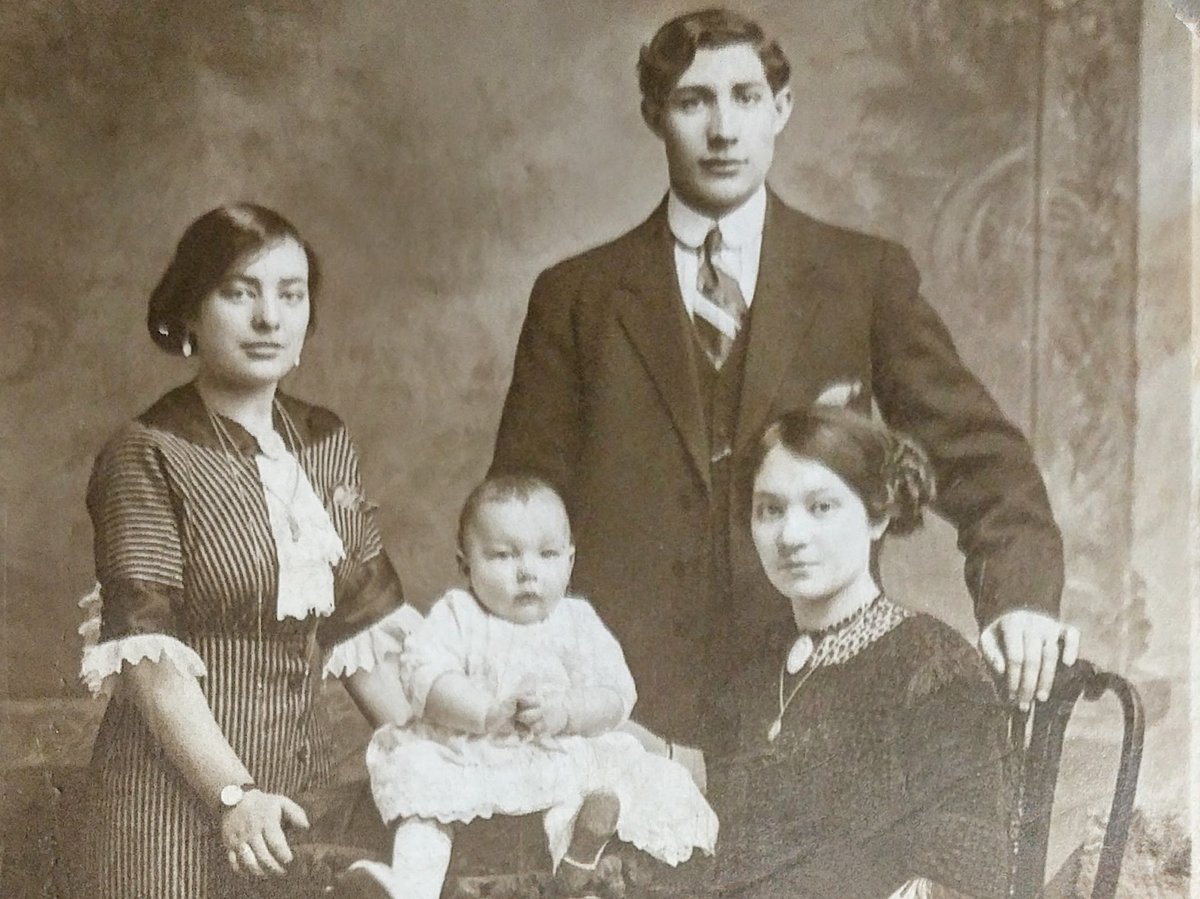
The Pairos family arrived in Scotland in the early 1900s after a wave of violent antisemitic pogroms rocked communities across the Russian Empire. Glasgow was a way station for Jews on their way to the United States, but some put down permanent roots. The Pairos children were orphaned and abandoned soon after their arrival, but a few nevertheless managed to become prosperous citizens of Glasgow.

The head of the family, Eliezer Pairos, was a well-educated teacher living in Dvinsk (present-day Daugavpils, Latvia) when the wealthy Cohen family of Smolensk hired him to tutor their children in Hebrew and prepare them for advanced education, according to family lore. Eliezer wooed the Cohens’ daughter Tirse, and they married around 1890.
Opportunities to teach Hebrew were few and far between when Eliezer arrived in Glasgow. He adopted the given name Louis and took work as a labourer, living in a crowded tenement at 20 Rose Street in Garnethill.1
Tirse and their six children, Fanny, Hyman, Rachel, Rebecca, Sarah, and Jack, joined Louis in 1908 after nearly a year apart. The oldest, Fanny, had just turned 16; the youngest, Jack, was a babe in arms.2 The family lived at Adelphi Street in the Gorbals, the centre of the Jewish community in Glasgow. The Gorbals was not exclusively Jewish, however, but a polyglot neighbourhood filled to bursting with immigrants from the Highlands, Ireland, and the Russian Empire, all crowded into tenements renowned for their squalor and dark, unsanitary back courts.
Immigrant families, like most of Scotland’s underclass, can be difficult to research. But Glasgow is unique in having preserved the city’s poor relief applications, now stored at the City Archives. These applications, filed with the local parish, recorded families at their lowest point and often contain detailed accounts of applicants’ lives and relationships. The multiple poor relief applications for members of the Pairos family provide insight into their tumultuous first years in the city.
By late spring of 1908 Tirse fell terribly ill and was diagnosed with bronchitis. Louis was not a member of any of the local Jewish friendly societies, which acted as a form of health insurance for their members, so he probably had no choice but to apply for poor relief in hopes of getting Tirse into the poorhouse and its infirmary. The Inspector of the Poor visited the family at Adelphi Street and denied Louis’ request: as new immigrants, the family was not considered “settled” in Govan Parish and thus not eligible for relief. Louis had the further disqualification of being able-bodied, even though his weekly earnings amounted to only 15 shillings a week, of which 12 went for rent.
Louis appealed the decision and Tirse was admitted to the poorhouse on May 28, 1908.3 She was briefly released, but six weeks later was in Royal Infirmary. The diagnosis of bronchitis was changed to pulmonary consumption, that is, tuberculosis, at that time a death sentence.
If Tirse had indeed come from a wealthy family, there was no evidence of it now. She was relying on Govan Parish, and perhaps Jewish welfare organisations, for her care. The Jewish community of Glasgow had a long history of taking care of their own, and as a result fewer Jewish families filed poor relief applications. But between 1881 and 1911 Glasgow’s Jewish population rose from around 1,700 to more than 12,000, and the relief organisations had a difficult time keeping up. 4
Tirse was sent by the relief board to Stobhill Hospital. Her daughter Fanny, affectionately called Fanishka, was recently employed as a tailor’s machinist and so new to Glasgow that she didn’t realise she could take a tram for a halfpenny to visit her mother.5 Instead she walked, although the hospital was more than an hour’s journey by foot from where the family lived in the Gorbals.

Tirse died at Stobhill on August 13, 1908 at the age of 37 or 38.7 Her youngest child, Jack, was not yet a year old.
Louis remarried quickly, a common expedient to keep the children from entering an orphanage. On October 31, 1908, Anna Slovinsky, a 25-year-old Jewish widow, suddenly became the stepmother of six children.8 Soon Louis and Anna had a child of their own, Solomon, who was born at 192 Govan Street on August 9, 1909.9
In August of 1910, just before his second child was born to his second wife, Louis disappeared.10 Why Louis left is unknown. He may have found the situation overwhelming. Or perhaps he thought his new wife and children would be better off without him, since the presence of an able-bodied, foreign husband and father made any sort of outdoor relief (that is, aid outside of the poorhouse walls) nearly impossible for his dependents. 11

Whatever Louis’ motives, he was one of many men who abandoned their families. In a report the previous year about the causes of desertion of wives and children, James Motion, the Glasgow Inspector of the Poor, blamed the trend on drunkenness, immorality, infidelity, and aversion to work. He did not attach great importance to possible economic causes, “because he is convinced that the evil at the root is moral, and not economic”.13
Anna Pairos applied for poor relief three days after Louis disappeared. She was weeks away from giving birth, had baby Solomon to care for, and was also responsible for six stepchildren. Fanny, age 17, and Rachel, then 15, both worked in the tailoring trade, bringing in a modest 12 and 9 shillings per week respectively. Anna received 9 shillings a week in poor relief.14
The family was probably also receiving assistance from the Jewish community — the Jewish Board of Guardians and the Glasgow Hebrew Ladies’ Benevolent Society were two of several organisations that provided aid to destitute Jews in the Gorbals. 15
This must have been an exceedingly difficult time for the Pairos family. Anna, already widowed once, had been deserted within two years of her second marriage, while heavily pregnant. The Pairos children, having emigrated to a new country whose language they didn’t speak, had lost their mother a few months later and then were deserted by their father. Jack, the youngest of Louis’ children, experienced all this before the age of three. His childhood filled with loss and privation later proved impossible for him to overcome.
Fanny, on the other hand, seemed determined to succeed. She met a young tailor at her workplace, Israel Mail, a Jewish immigrant from Odessa, who was, like her, a go-getter. Several months after her father left, when Fanny was 18, she married Israel and they set up house at 216 Govan Street.16 On the 1911 census her younger siblings lived with their stepmother just around the corner.17

Poor relief applications can sometimes contain information added after the initial filing. For example, Anna Pairos’ file notes that her toddler son Solomon was sent to the poorhouse for four months in 1911. It was usual for a child to be sent to the poorhouse (presumably to the hospital therein) without his mother accompanying him, but it’s possible the decision was made to send him alone because Anna was still caring for several young Pairos children, including a sickly baby. 19
Anna’s youngest died at 18 months of measles and bronchopneumonia.20This seems to have been too much for Anna to bear. A 1913 note on her poor relief application says, “Off rolls. Gone to Russia”. She presumably took her young son Solomon with her, but she deserted Louis’ children.
Now the Pairos children were truly orphaned. With their mother dead, abandoned by their father and their stepmother, they were left to fend for themselves. Rachel, at 17, was the eldest of the children still at home, while Jack and Sarah were 6 and 8. It is likely their older sister Fanny gave them assistance or even a place to stay for a time, but she was now starting her own family and busy helping to run the tailoring business that her husband had started.
Their story becomes more difficult to trace during this new upheaval in their lives, with the most detail being found on a poor relief application that Rachel made for her brother Jack in 1915.21 He was 8 years old, (although his application claimed he was 10), and Rachel requested his admission to the Gertrude Jacobsen Orphanage, a home for orphaned or abandoned Jewish children. At the time of the application Jack boarded with a Russian Jewish family named Verbelove, and Rachel boarded with another family named Glass. Jack was admitted to the orphanage and was still there six years later, recorded on the 1921 census. 22

In later years, Fanny recounted that after their step-mother left and the children were all on their own, friends told her she could get money to help her out of she applied to the Board of Guardians, but Fanny declined, saying “I don’t want it, I’ll work for them” and about charities, “I didn’t go near them”.23
In 1920, Rachel married Philip Price.24 She was 24 years old and working as a tailoress. The marriage gave her stability, and in 1922 Rachel rescued her little brother Jack from the orphanage. The note on his poor relief application reads, “Off roll, adopted by sister”.25
Rebecca and Sarah boarded with a widow, Etta Green, a Russian Jewish immigrant to Glasgow. According to the 1921 census, both worked in the tailoring business, Sarah as a machinist and Rebecca as a tailoress.26 Sarah married Solomon Brem in 1925 at her sister Fanny’s flat at 14 Warwick Road.27 Solomon was a decorated veteran of the Great War. Like Rachel’s husband, he had been born in Britain to Russian Jewish immigrants.
In 1930, Rebecca, who lived with her sister Fanny, gave birth to a son.28 Frank was recorded without a father’s name on the birth certificate, and he died a few months later. 29
Despite the loss and hardship they endured, Louis and Tirse’s children survived. Some, like Fanny and Rachel, lived the rest of their lives in Glasgow. Both were immigrant success stories — hard-working young women who had made something of their lives. Fanny and her husband ran a successful tailoring business and eventually made the move that Jews in the Gorbals dreamed of — to a house in Newton Mearns, an upmarket suburb outside the city. Rachel was the proud mother of four children, and although she left the Gorbals, she stayed in Glasgow’s Southside until her death at age 86.30 Sarah and her husband prospered, too. They eventually left Glasgow to follow their son to New Zealand.31
Rebecca’s story seems to have been less happy. She never married, and according to family memories became increasingly eccentric as she aged. She retired from the tailoring business and lived in Ayrshire to the age of 96. 32
The saddest story was that of Jack, who spent most of his childhood in boarding houses and orphanages. He worked as a seaman, and while in Canada (where it was rumoured his father Louis may have fled) he deserted his ship. After being arrested for an unrelated crime, Jack was deported back to the United Kingdom.33

After multiple run-ins with the authorities in England, they too tried to wash their hands of him. Deportation was not possible, as the superintendent of police declared him “a man without a country”, and he was put into penal servitude instead.34 His criminal record forms a file six inches thick.
My family emigrated from Odessa to Glasgow with Israel Mail, Fanny Pairos’ husband, but like many, our branch continued onwards to New York. I now live in Glasgow, the city where my grandfather was born. I am part of the most recent wave of immigrants to Glasgow, but I also walk the streets my family walked more than a century ago and have the opportunity to explore the city’s treasure trove of genealogical records. Best of all has been meeting my Scottish cousins, the descendants of the Pairos children who persevered.
This was originally published in the Glasgow and West of Scotland Family History Society Journal, issue 128. Please consider joining the GWSFHS! It’s a fantastic resource for anyone researching Scotland, and if you’re in Glasgow be sure to visit their research centre in Partick.
Govan Parish. Application for poor relief in Govan Parish [Glasgow]. PIROSE, Louis. 27 May 1908. D-HEW/17/615 No. 100967. Glasgow City Archives, Mitchell Library, Glasgow, Scotland. ↩
Govan Parish. Application for poor relief in Govan Parish [Glasgow]. PARUSE, Jessie Cohen. 17 August 1908. D-HEW/16/13/125 No. 18654. Glasgow City Archives, Mitchell Library, Glasgow, Scotland. ↩
Application for poor relief in Govan Parish [Glasgow]. PIROSE, Louis. ↩
Neville Lamdan and Michael Tobias, ‘Two hundreds years of Scottish Jewry: a demographic and genealogical profile’ in Avotaynu, xxviii, no. 1 (Spring, 2012) pp. 21-23. ↩
Morris Slater, ‘One of the old school’ Jewish Echo, date unknown, circa 1976. Provided by Mail family. ↩
Deaths (CR) Scotland. Springburn, Lanarkshire [Glasgow]. 30 August 1908. PARIOS, Jessie. 644/6 742. ↩
Deaths (CR) Scotland. Springburn, Lanarkshire [Glasgow]. 30 August 1908. PARIOS, Jessie. 644/6 742. ↩
Marriages (CR) Scotland. Hutchesontown, Glasgow. 31 October 1908. PAIROSE, Louis and SLOBINSKY, Anna. 644/15 263. ↩
Births (CR) Scotland. Hutchesontown, Glasgow. 9 August 1909. PAIROSE, Solomon. 644/15 1163. ↩
Govan Parish. Application for poor relief in Govan Parish [Glasgow]. PAIROSE, Hannah. 13 August 1910. D-HEW/17/665 No. 124131. Glasgow City Archives, Mitchell Library, Glasgow, Scotland. ↩
“In 1908 only 75 Jews were receiving poor relief in all of Scotland”, Kenneth E. Collins, Second City Jewry (Glasgow, 1990), p. 162, quoting Glasgow Hebrew Congregation Minutes, 31 Dec 1908. ↩
Marriages (CR) Scotland. Hutchesontown, Glasgow. 31 October 1908. PAIROSE, Louis and SLOBINSKY, Anna. 644/15 263. ↩
Glasgow Parish Council, Desertion cases, memorandum, pp 1-2. ↩
Application for poor relief in Govan Parish [Glasgow]. PAIROSE, Hannah. ↩
Collins, Second City Jewry pp. 101-116. ↩
Marriages (CR) Scotland. Gorbals, Glasgow. 1 January 1911. PAIROS, Fanny and MAIL, Israel. 644/17 30; Census records. Scotland. Hutchesontown, Govan, Glasgow. 2 April 1911. MAIL, Israel (head). 644/15 28/3. SN 13. ↩
Census records. Scotland. Hutchesontown, Govan, Glasgow. 2 April 1911. PAIROS, Anna (head). 644/15 10/20. ↩
Census records. Scotland. Hutchesontown, Govan, Glasgow. 2 April 1911. PAIROS, Anna (head). 644/15 10/20. ↩
Births (CR) Scotland. Hutchesontown, Glasgow. 26 August 1910. PAIROSE, Rebecca. 644/15 1263. ↩
Deaths (CR) Scotland. Bridgeton, Glasgow. 25 March 1912. PAIROSE, Rebecca. 644/ 287. ↩
Govan Parish. Application for poor relief in Govan Parish [Glasgow]. PAIROS, John (Jack).16 June 1915. D-HEW/17/772 No. 171565. Glasgow City Archives, Mitchell Library, Glasgow, Scotland. ↩
Census records. Scotland. Cathcart, Glasgow. 19 June 1921. PAIROS, Jack. 633/B26/B20. ↩
Slater, One of the old school’. ↩
Marriages (CR) Scotland. Gorbals, Glasgow. 3 February 1920. PERRIS, Rachel and PRICE, Philip. 644/17 63. ↩
Application for poor relief in Govan Parish [Glasgow]. PAIROS, John (Jack). ↩
Census records. Scotland. Gorbals, Govan, Glasgow. 19 June 1921. PERRIS, Rebecca and Sarah. 644/17 14/18. ↩
Marriages (CR) Scotland. Gorbals, Glasgow. 23 August 1925. PERRIS, Sarah and BREM, Solomon. 644/17 245. ↩
Births (CR) Scotland. Springburn, Lanarkshire [Glasgow]. 27 September 1929. PERRIS, Frank. 644/6 1330. ↩
Deaths (CR) Scotland. Springburn, Lanarkshire [Glasgow]. 22 March 1930. PERRIS, Frank. 644/6 329. ↩
Deaths (CR) Scotland. Glasgow. 11 October 1981. PRICE, Rachel. 607/777; Monumental inscriptions. Scotland. Glenduffhill Cemetery, Glasgow. 12 October 1981.PRICE, Rachel PERRIS (Rochel Bas Reb Lazer). Row 8C, Plot 412. ↩
Register of Persons Granted New Zealand Citizenship 1949-1968. BREM, Sarah. 14 Mar 1967. Certificate register 169. p. 477. [Transcription]. Collection: New Zealand, Naturalisations, 1843-1981, ancestry.co.uk. ↩
Deaths (CR) Scotland. Ayr. 15 October 1998. PERRIS, Bessie. 608/702. ↩
Criminal Record Office New Scotland Yard. Zelig PERRIS criminal record. PERRIS, Zelig. Aliases PAIROS, Jack, PAROS, Jack, PERRIS, Jack, HARRIS, Jack. 17 January 1931. Metropolitan Police: criminal record office, habitual criminals’ registers and miscellaneous papers. MEPO6. PN 43. National Archives (Great Britain), Kew, England. Collection: England & Wales, Crime, Prisons & Punishment, 1770-1935, ancestry.co.uk. ↩
Birmingham Gazette. 6 Oct. 1936, p. 5c. ↩